ps28
«Золушка» Джоаккино Росcини. Дирижер Маурицио Беннини/Maurizio Benini. Режиссер Чезаре Лиеви/Cesare Lievi. Метрополитен-опера
Многократность в квадрате
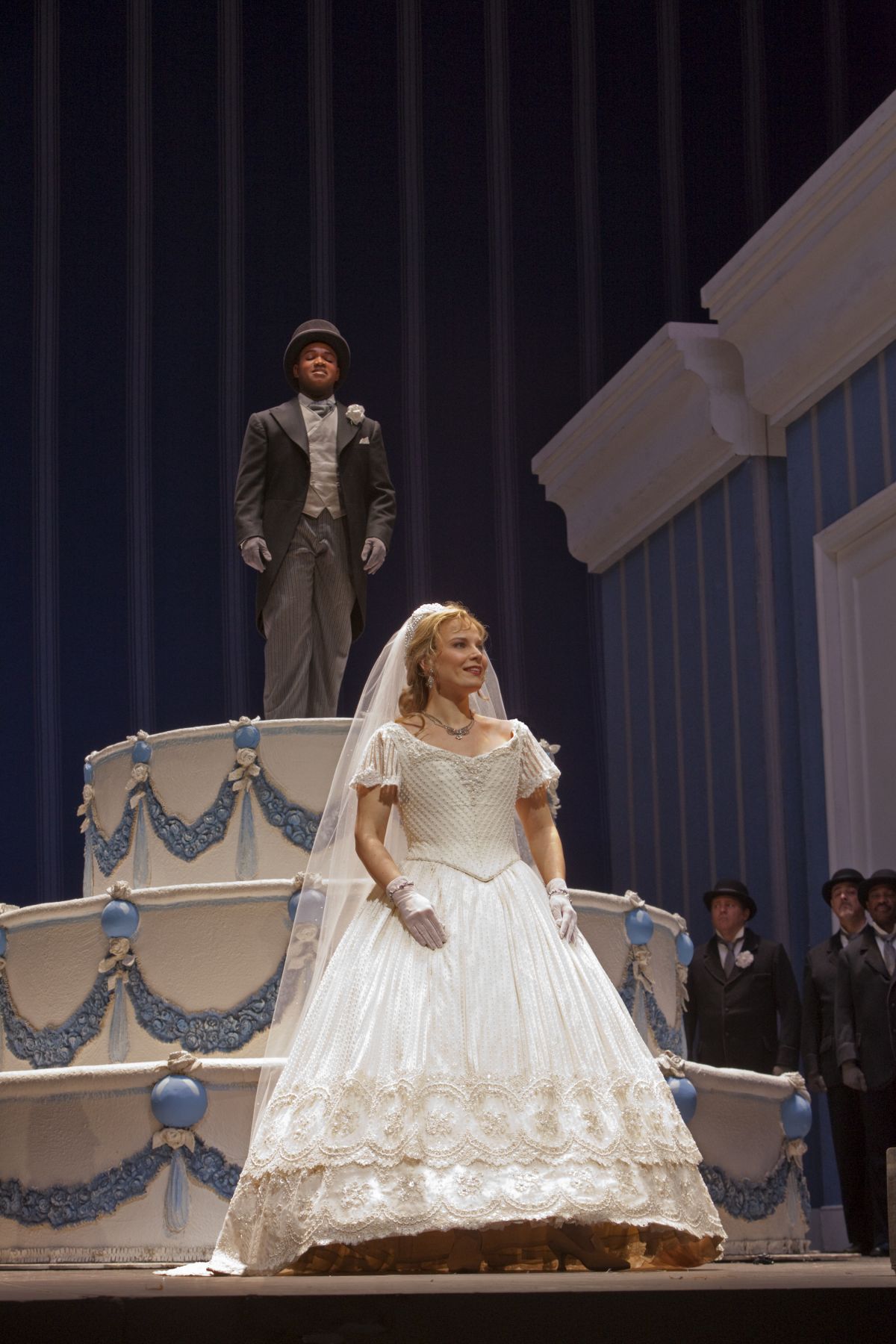
René Magritte’s images, inspiring the stage design and the costumes made by Maurizio Balo, create a surreal atmosphere in the performance. Magritte’s intellectual play with an object, or the replacing of the person with an object gives an unexpected timelessness to the buffoonery opera. One of the greatest achievements of the performance is the suggested movement towards the reevaluation where the surreal decisions are interpreted atypically for this fairy tale and the belcanto opera; once noticed, they are pushed away from the picture. However, a moment later those blurs start making sense in light of the ongoing events and they come back onto the map without interrupting a single image. The magical ending of this fairy-tale concludes when Cinderella and the Prince are presented as a toy couple on a wending cake.
In the new production in the Metropolitan Opera in 1997, the part of Angelina (the real Cinderella’s name) was played by Cecilia Bartoli. The production was considered to be such a success that it is still produced almost every season with various casts. In the late 2009 production, Cinderella’s part was performed by Elina Garanca, who had started her career in the Riga Opera Theatre. Since her American debut in «Seville Barber» the New York audiences have been admiring her performances. But Garanca, focusing on the new repertoire, does not want to be bound only to Rossini. Nevertheless, Elina’s brilliant stage presence [portrayal], her voice and artistic talent absolutely fit the image of Rossini’s opera and thus make it a little hard for her to achieve her desire. Garanca’s Cinderella’s performance as a maid in the beginning of the play is exceptional. In this house, in the manner of Magritte and the opera itself, the constant conversion and shifting of reality transform pictures into complicated concepts. The proportions of people and objects look unrealistic. People appear not only through the doors, but also fall down from the ceiling in dozens. The rain starts leaking through the hole in the roof and Cinderella shields her sleeping stepfather with an umbrella. A blazing flash of lightning strikes from above stripping the umbrella down to its bare spokes.
During the diverting transformations, the singers perform tongue-twister arias, complex vocal ensembles, mezzo and tenor coloraturas - up to the sextet of the second act that arouse a storm of applause. «Elina Garanca was technically flawless… Her final aria «Не piu mesta» is a coloratura firework, revealing her extraordinary talent…» was reported in the local press, where they also praised Garanca’s beautiful voice, its silky grace and expressiveness.
The part of the Prince was performed by the American tenor, Lawrence Brownlee. His aria «Si, Ritrovarla Io Giuro» aroused thunderous applause. Alessandro Corbelli, in the part of the Stepfather, was very ludicrous and graceful. Rachelle Durkin (Clorinda) and Patricia Risley (Tisbe) perfectly complemented his expression, demonstrating their brilliant comical opera skills. John Relyea, Angelina’s guardian angel (and the Prince’s tutor), gives her a gorgeous dress – he is the magical character who changes her life. The actor performed his part with archness; golden wings attached to his shoulders trembled every time he put his hands into his pockets. Those who had seen the actor in the part of Mefistofel this season could really appreciate his dramatic talent. Angels and devils, light and dark change places in the performance, as well as in the fairy-tale: the walls spring up like pop up book pictures revealing either baron Manifico’s dreams (the Stepfather), or his house, or the Prince’s palace

In this opera Cinderella does not lose her shoe at midnight – she gives out one of the two alike bracelets to the Prince, and if he really loves her, he will be able to find her using the bracelet (the test moment). And he did. The miracle happened. Cinderella remained kind and generous, brilliantly performing the final rondo.
The miracle happened, as it had been expected. But, was it actually expected? While the world, as its spectator (this opera was performed in HD in many countries) worries about the economic crisis, overhead expenses and the delay of their dreams, the miracle of the opera, presented by the Metropolitan Opera, suddenly, but rather positively brought back the joy of life guaranteed by this theatre nearly every season.


 ps в вашем блогe
 ps в ваших новостях

 времена... года...
